

Cooler Weather, Bigger Adventures: Why Big Mike’s Jerky Belongs in Your Fall Adventure Bag—and Your Favorite Recipes
Summary:Cooler temperatures bring hiking trails, football weekends, camping trips, bonfires, road trips and evenings...
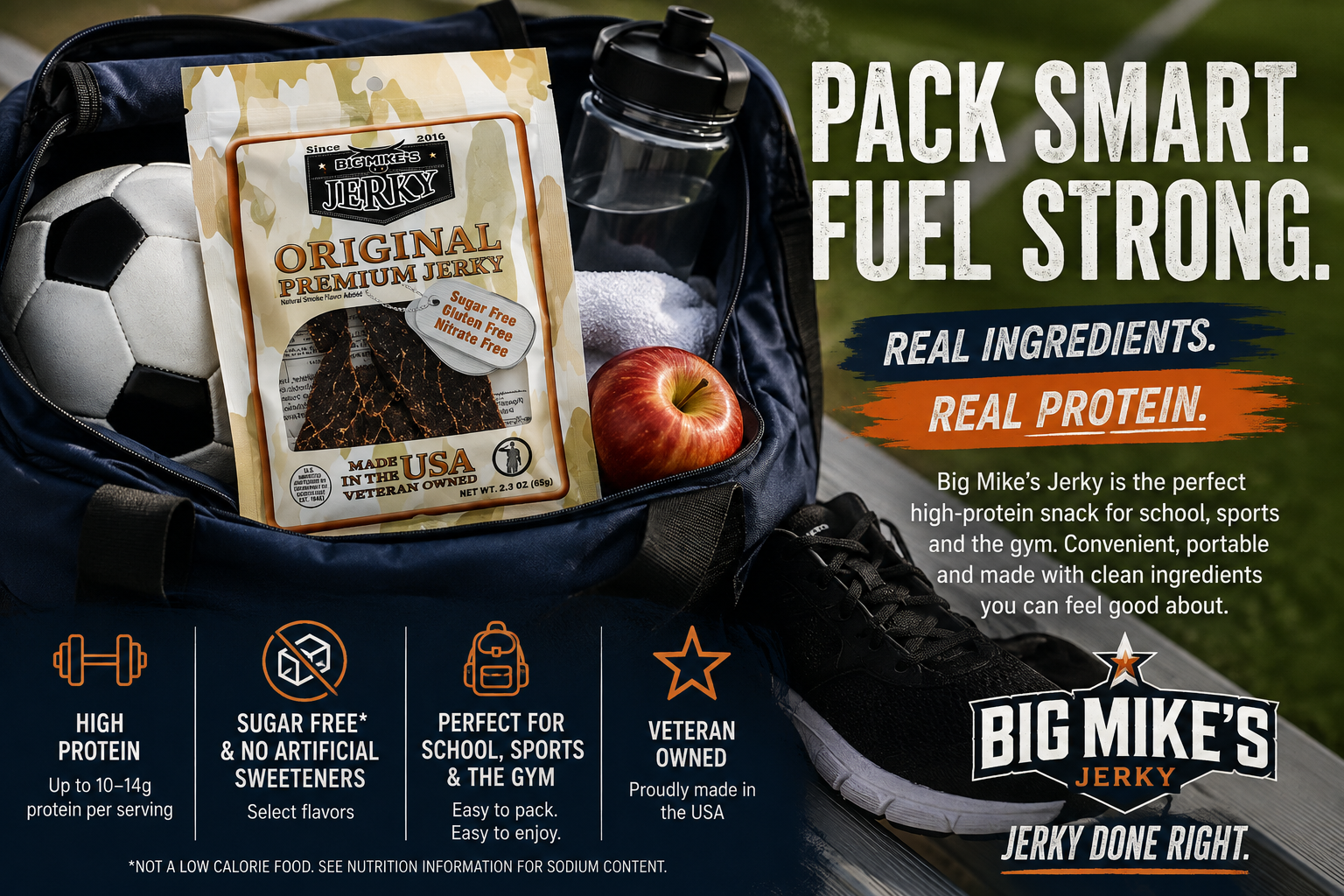
When school, practices, games and workouts return to the calendar, convenient snacks become essential—but convenience doesn’t have to mean candy, chips or sugar-heavy snack bars. Select Big Mike’s Jerky flavors offer high-protein, sugar-free snacking without artificial sweeteners in a portable package that can easily move from the school backpack to the soccer bag, gym bag or family car.
School starts at 7:30. Soccer practice begins at 4:00. There’s homework to finish, errands to run and maybe a workout squeezed in somewhere between work and dinner.
Sound familiar?
Now ask another question: What’s in everyone’s bag when hunger hits?
Is it a candy bar? A bag of chips? A sugary granola bar? Whatever happens to be available from the vending machine?
Or is there something satisfying enough to bridge the gap between school and practice, work and the gym, or one activity and the next?
Every August and September, families across America get reacquainted with packed calendars. Back-to-school season isn’t only about notebooks, new shoes and school supplies. It’s also the beginning of fall sports, practices, workouts, tournaments and long afternoons spent driving from one obligation to another.
And that’s when snack planning starts to matter.
For families and active adults looking for high-protein snacks for school, sports and the gym, jerky has one major advantage: it’s remarkably easy to take along.
Big Mike’s Jerky takes that convenience and pairs it with something increasingly important to ingredient-conscious consumers. Select varieties—including Original Beef, Peppered Beef, Spicy Beef and Original Turkey—are made without sugar or artificial sweeteners, according to current Big Mike’s product information.[1]
That makes them worth considering when it’s time to stock the backpack, sports bag, desk drawer or gym bag.
Most parents don’t need another lecture about healthy eating. They need food their kids will actually eat—and something that survives being tossed into a backpack.
That’s harder than it sounds.
Fresh fruit is nutritious, but bananas don’t always fare well beneath a math textbook. Yogurt and cheese require refrigeration. Sandwiches need preparation. Many packaged snacks travel beautifully but offer little beyond refined carbohydrates, sugar and salt.
That leaves parents trying to balance three things:
nutrition, convenience and acceptance.
Ideally, a snack should fit all three.
The American Academy of Pediatrics recommends keeping nutritious foods readily available for children and emphasizes snacks such as fruits, vegetables, dairy foods and other nutrient-rich choices rather than relying heavily on highly processed snacks and foods with added sugars.[2]
For children involved in sports, the challenge becomes even greater because growing bodies are also expending energy at practice.
Jerky isn’t meant to replace fruit, vegetables, whole grains or a balanced meal. But used alongside those foods, it can solve one piece of the puzzle particularly well: portable protein.
Protein tends to receive a lot of attention in fitness marketing, sometimes to the point of excess. You don’t need an enormous protein shake after every walk around the block.
But protein is essential.
It provides amino acids the body uses to build and maintain muscle, along with supporting numerous other functions throughout the body.
Growing children and teenagers need adequate protein as part of an overall balanced diet. Active teenagers may have somewhat greater needs than their less-active peers, although individual requirements depend on age, body size, sex, growth and activity level.[3]
That doesn’t mean young athletes should live on protein.
In fact, sports nutrition guidance emphasizes an important point that frequently gets lost in protein marketing: carbohydrates are a primary fuel source for athletic activity.[4]
So the smart approach isn’t to choose between protein and carbohydrates.
It’s to pair them.
That makes jerky especially useful as part of a more complete snack.
Try Big Mike’s Jerky with:
Now you’ve got portable protein plus carbohydrates that can help provide fuel for activity.
That’s far more useful nutritionally than pretending one food can do everything.
Consider a middle-school soccer player.
School ends around 3:00, but practice doesn’t start until 4:30. Lunch may have been several hours earlier.
That gap can be a nutritional danger zone.
Give a hungry child access to a vending machine and they’re probably not going to conduct a thoughtful nutritional analysis. They’re going to buy whatever looks good.
Instead, imagine opening the sports bag and finding:
A piece of fruit + a portion of Original Turkey Jerky + a bottle of water.
The fruit contributes carbohydrates. The turkey contributes protein. Water handles hydration.
Simple.
Portable.
And no complicated meal prep required.
The Academy of Nutrition and Dietetics specifically encourages families of young athletes to pack snacks and emphasizes carbohydrate-rich foods for athletic energy while incorporating a variety of nutrient-dense foods throughout the day.[4]
Jerky fits best as one component of that strategy, rather than the entire strategy.
Kids aren’t the only ones whose schedules change when school resumes.
For many parents, fall means returning to routines themselves.
Morning workouts restart.
Lunch-hour fitness classes get added back to the calendar.
Evening walks and gym sessions return after a summer filled with vacations, cookouts and unpredictable schedules.
That’s where keeping a shelf-stable protein option in the gym bag can be useful.
A bag of jerky doesn’t require a shaker bottle.
It doesn’t need refrigeration before opening.
It doesn’t melt in the car like some protein bars.
And unlike many sweet protein snacks, it provides a savory alternative when another chocolate-covered bar sounds more like dessert than food.
Big Mike’s Original Beef Jerky, for example, currently provides 14 grams of protein per 1-ounce serving with 0 grams of sugar, according to the product’s nutrition information.[1]
For someone heading from work directly to the gym—or leaving the gym with another hour before dinner—that combination of convenience and protein can be particularly useful.
The conversation around sugar has changed significantly.
For years, manufacturers often responded to consumer demand for less sugar by replacing sugar with high-intensity sweeteners.
Some consumers are perfectly comfortable with those ingredients.
Others aren’t.
Increasingly, shoppers are looking for products that simply aren’t sweet.
That’s one reason savory, sugar-free snacks have become appealing.
Rather than taking a traditionally sweet snack and replacing the sugar with another sweetener, certain Big Mike’s Jerky recipes take a different route: they simply don’t rely on sweetness in the first place.
Original Beef builds flavor around beef, garlic, onion, smoke and savory seasoning.
Peppered builds from that foundation with black pepper.
Spicy adds cayenne for additional heat.
Original Turkey offers a poultry-based alternative while maintaining the straightforward savory profile.
For consumers tired of discovering sweetness in nearly every packaged food, that’s refreshing.
The nutritional benefits of a snack don’t matter if nobody remembers to pack it.
This is one area where shelf-stable foods have a considerable advantage.
You can put jerky in:
and it’s there when you need it.
That may sound trivial, but convenience strongly affects actual eating behavior.
Healthy snack intentions have a habit of disappearing when you’re hungry, running late and twenty minutes from home.
Having something already packed makes the better choice the easier choice.
For a family preparing for school on Sunday night, this can be as simple as creating a snack station with grab-and-go options.
Put jerky beside whole fruit, unsweetened applesauce, whole-grain crackers and other portable choices.
Then grabbing tomorrow’s snack takes seconds rather than another ten minutes during the morning rush.
Picture a 16-year-old volleyball player.
She eats lunch at 11:15 a.m.
Practice begins at 3:30.
By the time she gets to the gym, she’s hungry—and a hard practice is about to begin.
The wrong conclusion would be:
“She needs protein, so give her jerky.”
The better conclusion is:
She needs fuel.
A banana, whole-grain crackers or another carbohydrate-rich food can provide useful pre-practice energy. A reasonable portion of jerky can contribute protein as part of the overall snack.
Sports nutrition isn’t about maximizing a single nutrient. It’s about providing enough total energy and a mix of nutrients to support growth and activity.
That’s especially important for young athletes. The American Academy of Pediatrics warns that athletes who chronically fail to consume enough energy to meet the demands of growth and sport can develop Relative Energy Deficiency in Sport, or RED-S.[5]
In other words, this is not a story about eating less.
It’s about eating better and adequately.
Tournament weekends can turn normal family eating habits upside down.
You’re leaving the house at 6:30 a.m.
Game one is at 8:00.
Game two is at 11:30.
There’s another game at 3:00.
The concession stand becomes lunch.
This is exactly when a well-stocked sports bag earns its keep.
A cooler can hold sandwiches, fruit, vegetables and beverages. Shelf-stable foods such as jerky, crackers and dried fruit can fill the gaps.
Big Mike’s Jerky shouldn’t replace a proper meal during a long tournament day.
But it can prevent the familiar situation where someone suddenly announces, “I’m starving,” and the only available option is candy, nachos or a giant sports drink.
There’s one item that belongs in every sports bag before jerky:
water.
The American Academy of Pediatrics identifies plain water as a preferred beverage for children and emphasizes regular hydration throughout the day.[6]
That’s particularly important when eating jerky because dried meat is naturally a more concentrated food and typically contains meaningful amounts of sodium.
So while jerky travels exceptionally well, it should travel with a water bottle.
For most routine school days and shorter recreational activities, water is usually the logical beverage. Sports drinks can have a role during prolonged or particularly intense exercise, but they aren’t automatically necessary simply because someone is wearing a uniform.[4]
Consumers should also look beyond the front of the package.
Jerky is a preserved meat product, and sodium is an important consideration.
For example, Big Mike’s Original Beef Jerky lists 430 mg of sodium per 1-ounce serving on its current nutrition information.[1]
That doesn’t automatically make jerky a “bad” food.
It means portion size and the rest of the day’s diet matter.
If the rest of someone’s diet is already very high in sodium, that’s worth considering. Children with specific dietary or medical needs should follow guidance from their pediatrician or registered dietitian.
The smartest consumers don’t label foods as universally “good” or “bad.”
They ask how a food fits into the bigger picture.
The same principle applies to sugar-free foods.
Seeing “0g sugar” isn’t permission to ignore the Nutrition Facts panel.
Parents should pay attention to:
Portion awareness is particularly important with children because the serving size printed on an adult-oriented packaged product isn’t necessarily the ideal portion for every child’s age or appetite.
The American Academy of Pediatrics notes that a Nutrition Facts serving size is a standardized amount—not necessarily a recommendation for exactly how much an individual child should eat.[7]
Let hunger, age, activity and the rest of the meal or snack help guide portions.
Ingredient-conscious consumers should also check the specific flavor they’re buying.
Several Big Mike’s varieties—including Original Beef, Peppered Beef, Spicy Beef and Original Turkey—are currently marketed as sugar-free, and product information describes them as being made without artificial sweeteners.[1]
Other recipes are different.
For example, the upcoming Teriyaki Turkey Jerky develops its sweetness through coconut aminos. That product contains naturally derived sugars and should not be confused with the company’s 0-gram-sugar varieties.
That’s an important distinction—and a good example of why reading the Nutrition Facts panel beats relying on broad assumptions about an entire brand.
Different flavor. Different recipe. Check the label.
There are plenty of protein snacks available.
The question isn’t whether jerky exists.
It’s why choose one brand over another?
Big Mike’s Jerky is a veteran-owned small business whose story began with an effort to make straightforward, great-tasting jerky with fewer unnecessary ingredients. The company emphasizes small-batch production, traditional jerky texture and high-protein recipes, and several of its core flavors contain zero grams of sugar.[1]
That’s particularly relevant during back-to-school season because parents and athletes aren’t necessarily looking for the trendiest snack.
They’re looking for something dependable.
Something that tastes good.
Something that won’t be crushed in a backpack.
Something that doesn’t require refrigeration.
And something they’ll actually remember to eat.
Sometimes the best snack isn’t complicated.
Back-to-school and sports season is busy enough.
Snack planning shouldn’t make it harder.
Big Mike’s sugar-free jerky varieties offer a convenient way to keep protein within reach whether you’re packing a child’s backpack, stocking a teenager’s sports bag or preparing your own gym bag.
But the smartest approach isn’t simply tossing in a bag of jerky and calling nutrition handled.
Pair protein with fruits, whole grains or other carbohydrate-containing foods when athletes need energy. Pack water. Pay attention to portions and sodium. And remember that children and teenagers need enough overall food to support both growth and activity.
That’s what sensible sports nutrition looks like.
Not perfection.
Not complicated formulas.
Just better choices made easier.
When the school bell rings, the practice whistle blows or you’re rushing from work to the gym, having a satisfying high-protein snack already packed can be the difference between choosing intentionally and grabbing whatever happens to be nearby.
This season, along with the cleats, notebooks, water bottle and gym shoes, consider making room for a little Big Mike’s, too.
What’s your family’s go-to snack during back-to-school and sports season? Do you keep emergency snacks in the backpack, car or gym bag?
Tell us in the comments—we’d love to hear what’s working for your family.
And if you know another parent, athlete, coach or gym-goer who is always looking for better grab-and-go snack ideas, share this article on social media and help make busy-season snacking a little easier.
Summary:Cooler temperatures bring hiking trails, football weekends, camping trips, bonfires, road trips and evenings...

Continuing our pillar article: Why Big Mike's Teriyaki Turkey Jerky Deserves a Place in Your Healthy Snack Rotation...

Today's consumers are looking beyond flashy packaging and marketing claims in search of snacks that deliver real...
0 Comments